
If you have opened a Destiny Matrix chart for the first time, it can look confusing: a star-shaped diagram, many circles, numbers from 1 to 22, diagonal lines, age markers, and labels such as love, money, talents, purpose, and karmic patterns.
This guide explains the chart from zero. You do not need to know numerology, Tarot, astrology, or spiritual terminology before reading it. By the end, you should understand what the Destiny Matrix is, what the main parts of the chart represent, and how to start reading your own chart without feeling lost.
Before you continue, this visual walkthrough can help you recognize the main chart positions and see how the diagram is usually discussed in practice.
The Short Answer
A Destiny Matrix is a birth-date-based numerology chart. It takes your date of birth, reduces parts of it into numbers from 1 to 22, and places those numbers into a geometric chart. Each position in the chart represents a different life theme.
Think of it as a reflection map, not a prediction machine.
It can help you ask questions such as:
- What energy or pattern is central in my personality?
- What strengths may feel natural to me?
- What recurring lessons or challenges should I pay attention to?
- How do I tend to approach love, money, work, and purpose?
- Which themes repeat across different areas of my life?
It should not be used as a medical, legal, financial, or relationship verdict. The chart can point to themes for reflection, but it does not remove personal choice, professional advice, or common sense.
Where the Destiny Matrix Comes From
The Destiny Matrix is commonly described as a modern esoteric numerology system connected with the work of Natalia Ladini. It combines several symbolic traditions:
| Influence | What it contributes |
|---|---|
| Numerology | The idea that birth-date numbers can be interpreted symbolically. |
| Major Arcana-style archetypes | The 1-22 number range and archetypal meanings often linked with Tarot language. |
| Energy and chakra language | A way to describe personal, emotional, and spiritual balance. |
| Chart interpretation | A structured diagram that separates life themes into different zones. |
You do not need to believe every part of that background to use the chart. Many people approach it as a journaling tool: a structured way to notice patterns, reflect on decisions, and think about personal growth.
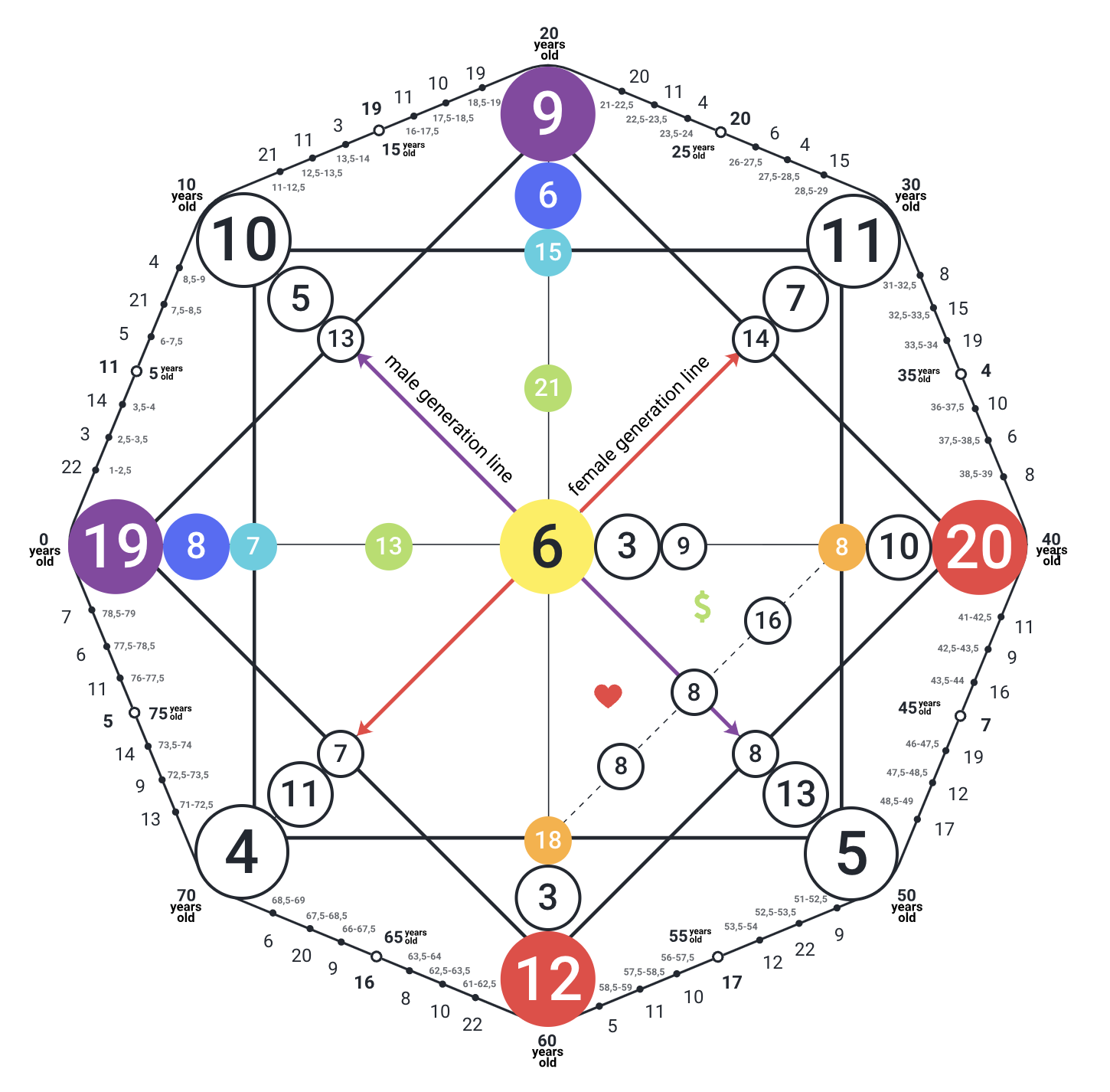
What the Chart Looks Like
Most Destiny Matrix charts are built around an eight-pointed star or octagram. Visually, it often looks like two squares placed over each other.
The chart usually includes:
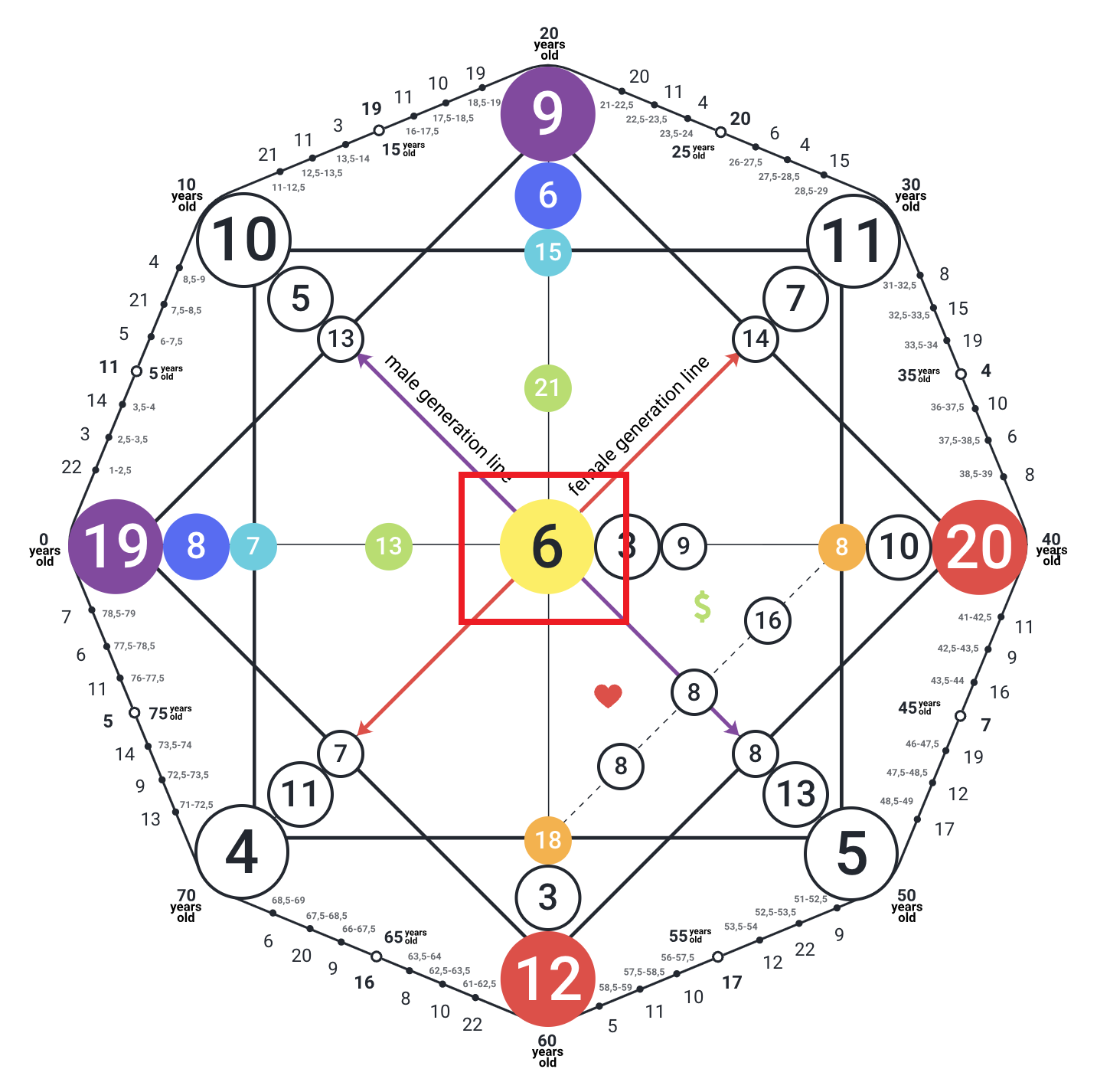
- A center number
- Outer corner numbers
- Inner support numbers
- Diagonal and horizontal lines
- Love and money lines
- Karmic or generational positions
- Age-cycle markers around the outside
The most important beginner idea is this: the same number can mean different things depending on where it appears.
For example, a number in the center speaks about your core energy. The same number on a money line speaks about how that energy may show up in practical life, resources, or work.
The Main Areas of a Destiny Matrix Chart
Different practitioners name positions in slightly different ways, but most beginner readings include these major zones.
1. Core Energy
The center of the chart is usually the first place to look. This number describes the main energy, archetype, or inner theme associated with the birth date.
For a beginner, read it as:
- Your default way of meeting life
- A pattern that may repeat in many areas
- A starting point for self-reflection
- The theme that gives context to the rest of the chart
If the center number feels accurate, it can make the rest of the chart easier to understand. If it does not feel accurate, do not reject the whole chart immediately. Sometimes a center energy describes potential, not a fully developed behavior.
2. Portrait or Social Image
Some chart systems include a portrait zone or social image zone. This area is about how your energy may appear to other people.
It can reflect:
- First impressions
- How you naturally present yourself
- What others may notice before they know you deeply
- The difference between your inner self and outer expression
This is useful because people often confuse "who I am inside" with "how I come across." A Destiny Matrix reading can separate those two questions.
3. Karmic Tail or Growth Lessons
The karmic tail is one of the areas beginners often misunderstand. It does not mean you are doomed or punished. In practical terms, it points to patterns that may need more awareness.
Read this zone as:
- Repeating lessons
- Habits that may slow growth
- Skills you may need to develop
- Emotional reactions that are worth observing
A healthy interpretation should feel like a prompt, not a sentence. For example: "Where do I repeat this pattern?" is more useful than "This number controls my life."
4. Love Line
The love line is connected with relationship patterns. It may describe how a person gives love, receives love, reacts in close bonds, or repeats emotional dynamics.
For beginners, use it to reflect on:
- What you tend to seek in connection
- What may feel safe or unsafe in relationships
- Where attraction and fear can mix
- How you can communicate more consciously
It is not a compatibility guarantee. A good relationship still depends on communication, emotional maturity, timing, values, and choices.

5. Money Line
The money line is about practical life, resources, work style, and material flow. It is not a financial forecast.
Useful questions include:
- What motivates me in work?
- Where do I block action, confidence, or consistency?
- Do I earn best through structure, creativity, service, leadership, analysis, or communication?
- What kind of responsibility around money do I need to develop?
The best way to read the money line is as a behavioral mirror. It can help you notice patterns, but it cannot promise income.
6. Talents and Natural Gifts
Talent positions point to strengths that may come naturally, feel familiar, or develop easily with practice.
They can describe:
- Creative ability
- Communication style
- Leadership potential
- Teaching, healing, organizing, building, analyzing, or inspiring
- Abilities you may overlook because they feel "too normal" to you
This zone is often useful for career reflection, but it should be read together with practical experience.
7. Family, Lineage, and Generational Patterns
Some chart positions connect with family or ancestral patterns. These do not need to be interpreted literally. A beginner can read them as inherited themes:
- Beliefs you absorbed early
- Patterns you saw in family relationships
- Emotional habits passed through generations
- Strengths and burdens from your background
This area can be sensitive. Keep the interpretation grounded and respectful.
8. Life Cycles and Purpose
Many Destiny Matrix charts include age markers or cycle points around the outside. These suggest that different themes may become more visible at different life stages.
Beginners should treat cycles as reflection windows:
- What theme was active in childhood?
- What changed around major life transitions?
- Which lesson seems to return in adulthood?
- What direction feels more meaningful now?
Cycles are not fixed prophecies. They are prompts for reviewing life phases.
What the Numbers 1-22 Mean
Destiny Matrix numbers usually run from 1 to 22. Each number is interpreted as an archetype, meaning a symbolic pattern rather than a literal label.
Here is a simple beginner map:
| Number | Beginner keyword | Reflection question |
|---|---|---|
| 1 | Initiative | Where do I need to lead or begin? |
| 2 | Sensitivity | Where do I need to listen and cooperate? |
| 3 | Creativity | How do I express joy, beauty, or ideas? |
| 4 | Structure | What needs discipline, order, or stability? |
| 5 | Learning | What am I here to study, teach, or question? |
| 6 | Choice | What do love, values, and commitment ask of me? |
| 7 | Direction | Where do I need focus and self-mastery? |
| 8 | Responsibility | How do I use power, fairness, and resources? |
| 9 | Wisdom | Where do I need depth, solitude, or reflection? |
| 10 | Change | How do I respond when life turns suddenly? |
| 11 | Strength | What requires courage and inner control? |
| 12 | Surrender | Where do I need patience or a new perspective? |
| 13 | Transformation | What is ending so something new can grow? |
| 14 | Balance | Where do I need moderation and healing? |
| 15 | Desire | What attachment or temptation needs awareness? |
| 16 | Awakening | What false structure is being cleared? |
| 17 | Hope | Where can I trust inspiration and renewal? |
| 18 | Intuition | What fears, dreams, or emotions need clarity? |
| 19 | Vitality | Where can I be more open, joyful, or visible? |
| 20 | Calling | What is asking for renewal or responsibility? |
| 21 | Completion | What is ready to integrate or finish? |
| 22 | Freedom | Where do I need trust, openness, or a new start? |
These meanings are intentionally simple. A full reading depends on the position, surrounding numbers, and repeated patterns.
How Beginners Should Start Reading a Chart
Do not try to decode every circle at once. Use this order:
- Start with the center number.
- Look for repeated numbers.
- Read the love line only after understanding the center.
- Read the money line as behavior, not prediction.
- Review karmic patterns as growth prompts.
- Compare the chart with real life examples.
- Write down what resonates and what does not.
This order prevents the most common beginner mistake: jumping straight to love, money, or future predictions before understanding the basic structure.
A Simple Example
Imagine someone has a center number connected with leadership, but their portrait zone suggests diplomacy. That person may feel internally decisive but appear gentle or cooperative to others.
That is not a contradiction. It can mean:
- They lead best through collaboration.
- They may avoid direct leadership because they want harmony.
- Other people may underestimate their drive.
- Their growth may involve speaking clearly without becoming harsh.
This is how Destiny Matrix interpretation works: one number rarely tells the whole story. The value comes from comparing positions.
What a Destiny Matrix Can Help With
A grounded reading can support:
- Self-reflection
- Journaling
- Career questions
- Relationship conversations
- Awareness of repeated patterns
- Personal development planning
- Understanding strengths and growth areas
It is most useful when you treat it as a mirror. The chart gives language to patterns, but your life gives the evidence.
What a Destiny Matrix Cannot Do
A responsible Destiny Matrix reading should not claim to:
- Diagnose medical or mental health conditions
- Guarantee wealth, marriage, success, or failure
- Replace therapy, legal advice, or financial planning
- Decide whether you should stay in or leave a relationship
- Remove personal responsibility
- Predict exact future events
If a reading makes you feel powerless, afraid, or dependent, step back. A useful chart should increase self-awareness, not take away agency.
Destiny Matrix vs Numerology, Tarot, and Astrology
The Destiny Matrix overlaps with other systems, but it is not identical to them.
| System | Main input | Main focus |
|---|---|---|
| Traditional numerology | Name and/or birth date | Life path, expression, personal numbers |
| Tarot | Cards or archetypes | Symbolic guidance and reflection |
| Astrology | Birth date, time, and place | Planetary positions and timing |
| Destiny Matrix | Birth date | Chart positions, archetypal numbers, life themes |
The Destiny Matrix is simpler than astrology because it does not require birth time or location. It is more structured than a single life path number because it places several numbers into different life areas.
Beginner Checklist
Before you read your chart, keep this checklist nearby:
- I know my exact birth date.
- I understand that the chart is for reflection, not certainty.
- I will start with the center, not the most dramatic area.
- I will look for patterns across positions.
- I will compare the interpretation with real behavior.
- I will keep what is useful and question what does not fit.
Final Thoughts
The Destiny Matrix is best understood as a symbolic map of life themes based on your birth date. Its value is not that it gives one final answer. Its value is that it organizes questions.
For a beginner, the goal is simple: learn the chart slowly, connect each position with real experience, and use the numbers as prompts for better self-understanding.
Once you understand what the chart is, the next step is learning how to read each area in the right order.
Next guide: How to Read a Destiny Matrix Chart
