
Reading a Destiny Matrix chart is much easier when you use the right order. Beginners often look at the chart, see many numbers at once, and immediately ask, "Which number matters most?"
The answer is: start with the center, then read outward.
This guide walks you through the chart step by step. You do not need previous knowledge of numerology or Tarot. You only need your chart, your birth date, and a willingness to read the numbers as reflection prompts rather than fixed labels.
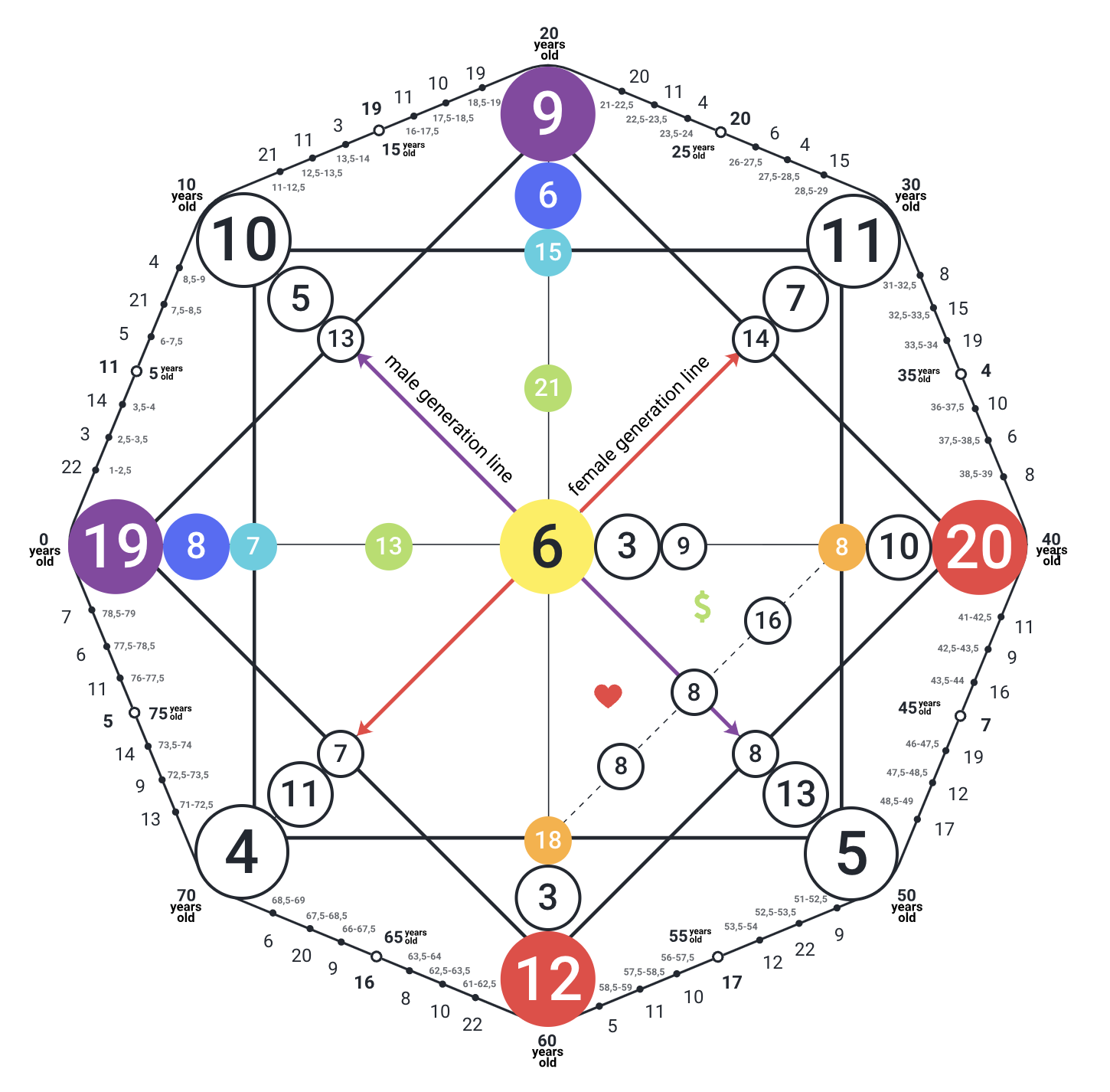
Before going through the steps below, watch this walkthrough to see how an experienced reader moves across the chart positions.
Before You Begin: Three Rules
Keep these rules in mind before interpreting anything.
Rule 1: Position matters more than the number alone
A number by itself is incomplete. A 6 in the love line is not read exactly like a 6 in the money line. The position tells you which life theme the number is speaking about.
Rule 2: Repeated numbers deserve attention
If the same number appears in several important areas, that theme may be stronger in the person's life. Repetition usually matters more than a single isolated number.
Rule 3: The chart is a mirror, not a verdict
Use the chart to ask better questions. Do not use it to decide that someone is "good," "bad," "lucky," "cursed," or unable to change.
The Beginner Reading Order
Use this order when reading any Destiny Matrix chart:
| Step | Area | Question it answers |
|---|---|---|
| 1 | Center / Core Energy | What is the main inner theme? |
| 2 | Portrait / Outer Self | How may this energy appear to others? |
| 3 | Repeated Numbers | Which themes show up more than once? |
| 4 | Karmic Tail | What growth pattern needs attention? |
| 5 | Love Line | How does the person approach closeness? |
| 6 | Money Line | How does the person approach work and resources? |
| 7 | Talents | What natural gifts should be developed? |
| 8 | Family / Lineage | What inherited patterns may be present? |
| 9 | Life Cycles | Which themes may become visible by life stage? |
You can come back to this table whenever the chart feels overwhelming.
Step 1: Read the Center Number
The center is the heart of the chart. It is often called core energy, central arcana, or personal energy.

Read the center number as:
- The main inner pattern
- The energy that colors the rest of the chart
- A core lesson or natural style
- The first number to understand before reading love, money, or talents
Ask:
- What does this number say about my natural way of acting?
- Does this describe who I am now, or who I am learning to become?
- Where does this energy show up in relationships, work, or decisions?
Example
If the center number is connected with structure, the person may need order, reliability, and clear systems. If the same person has a love line that asks for emotional flexibility, the reading becomes more nuanced: they may value stability, but relationships may ask them to soften control.
That is why the center is only the beginning.
Step 2: Read the Portrait or Outer Self
The portrait area describes how a person may be seen by others. It is not always the same as the center.
Read it as:
- First impression
- Social style
- How energy appears in public
- What others may notice before they understand the deeper person
Ask:
- Do people see me the way I see myself?
- Is there a gap between my inner self and my outer behavior?
- Do I hide my center energy behind a safer social style?
Example
Someone may have a center number linked with independence, but a portrait number linked with harmony. Inside, they may want to lead. Outside, they may appear agreeable. The growth question becomes: "How can I express leadership without losing kindness?"
Step 3: Look for Repeated Numbers
Before going into every zone, scan the chart for repetition.
Write down:
- Numbers that appear two or more times
- Numbers that appear in major positions
- Numbers that appear on both personal and practical lines
- Numbers that appear in both relationship and family zones
Repeated numbers can show:
- A strong life theme
- A lesson that repeats in different contexts
- A talent that keeps asking to be used
- A pattern that cannot be ignored
Simple repetition example
If 3 appears in the center, talents, and social image, creativity or expression may be a major theme. The person may need to speak, create, teach, perform, write, design, or bring beauty into life in some form.
If the same 3 appears with difficult surrounding numbers, the lesson may be learning to express without seeking constant approval.
Step 4: Read the Karmic Tail
The karmic tail is often the most emotionally loaded part of the chart. Read it carefully and calmly.
It can point to:
- Lessons that repeat
- Unfinished growth themes
- Habits that need awareness
- Emotional reactions that can limit freedom
- Skills the person is learning to develop
Do not read it as punishment. A grounded reading sounds like this:
"This area may show a pattern worth observing. Where does it appear in real life, and what would a more conscious response look like?"
Not like this:
"This number means your life will always be difficult."
Questions for the karmic tail
- What kind of situation keeps repeating?
- What reaction do I fall into automatically?
- What skill would change the pattern?
- What would I do differently if I were not acting from fear?
Step 5: Read the Love Line
The love line describes relationship dynamics. It can show how a person seeks closeness, what they desire, what they fear, and what growth may be needed in intimate connection.

Read the love line through three beginner questions:
| Question | What to look for |
|---|---|
| What do I seek in love? | Desire, attraction, emotional needs |
| What pattern do I repeat? | Fear, avoidance, control, idealization, dependency |
| What would healthier love require? | Communication, boundaries, patience, honesty, trust |
How not to read the love line
Do not use it to decide that a relationship must succeed or fail. Two people with challenging patterns can still build a healthy relationship if they are self-aware and willing to grow. Two people with easy-looking patterns can still struggle if they avoid communication.
Use the love line for conversation, not judgment.
Step 6: Read the Money Line
The money line is about work, resources, responsibility, confidence, material patterns, and practical energy. It is not a promise of wealth.

Beginner questions:
- What kind of work rhythm fits this person?
- Where does the person block action or consistency?
- Does this chart suggest earning through service, structure, leadership, creativity, communication, analysis, or transformation?
- What attitude toward money needs maturity?
- What practical habit would improve material stability?
Money line example
If the money line emphasizes structure, the person may do better with planning, systems, budgets, and repeatable work. If it emphasizes creativity, money may flow better when the person has space to create, communicate, design, or inspire.
This does not mean one path is guaranteed. It means the person should observe which work style supports their energy.
Step 7: Read Talents and Natural Gifts
Talent positions show abilities that may be natural, familiar, or easier to develop.
They can point to:
- Communication strengths
- Creative ability
- Leadership
- Teaching
- Organizing
- Healing or supportive roles
- Analysis and research
- Entrepreneurship
- Spiritual or intuitive sensitivity
The most common mistake is ignoring talents because they feel ordinary. A natural gift often feels "normal" to the person who has it.
Ask:
- What do people ask me for help with?
- What skill do I use without much effort?
- What did I enjoy before I started judging it?
- Which talent needs practice, not just recognition?
Step 8: Read Family and Lineage Patterns
Family or lineage positions can reflect inherited patterns. These may be emotional, behavioral, cultural, or relational.
Read this area gently.
It may show:
- Family strengths
- Unspoken expectations
- Patterns around authority, money, love, or duty
- Emotional habits learned early
- Gifts that came through family experience
This part of the chart is not about blaming parents or ancestors. It is about noticing what you may have absorbed and deciding what you want to continue or change.
Step 9: Read Life Cycles and Age Markers
Some charts show ages around the outside. These markers suggest that certain themes may become more visible during certain life periods.
Use them for reflection:
- What theme was active in childhood?
- What changed around the 20s, 30s, or 40s?
- Which lesson keeps returning?
- What is becoming more important now?
Do not read age markers as exact predictions. They are better used as timing prompts for journaling and review.
How to Combine Two Areas
A real reading is not just "number meaning + position meaning." You need to compare areas.
Core + Portrait
This shows the difference between inner self and outer expression.
Example question: "Do I show people who I really am, or only the version that feels safe?"
Core + Karmic Tail
This shows how the main energy can mature.
Example question: "What lesson helps my core energy become healthier?"
Love Line + Money Line
This shows how emotional life and practical life affect each other.
Example question: "Do my relationships support my work rhythm, or do they pull me away from stability?"
Talents + Money Line
This can be useful for career reflection.
Example question: "Which natural gifts could become practical skills?"
A Full Beginner Reading Example
Imagine a person has this simplified pattern:
| Area | Theme |
|---|---|
| Center | Independence and initiative |
| Portrait | Diplomacy and sensitivity |
| Karmic Tail | Learning patience and trust |
| Love Line | Strong desire for closeness, fear of losing freedom |
| Money Line | Success through structure and consistency |
| Talents | Communication and teaching |
A beginner interpretation might be:
This person may feel internally independent and self-directed, but other people may experience them as softer or more diplomatic. Their growth may involve learning patience instead of rushing. In relationships, they may want closeness but become uncomfortable when they feel controlled. In work, they likely need structure, and their communication talent could become a practical skill through teaching, writing, consulting, or guiding others.
Notice the language: "may," "likely," "could." A good reading leaves room for real life.
Common Beginner Mistakes
Mistake 1: Reading one number in isolation
Always ask where the number appears.
Mistake 2: Treating challenging numbers as bad
Challenging numbers often point to growth, not failure.
Mistake 3: Looking only at love and money
Love and money make more sense after you understand the center and repeated themes.
Mistake 4: Ignoring repeated numbers
Repetition is one of the easiest clues for beginners.
Mistake 5: Making predictions
The chart is better for self-awareness than certainty.
Quick Reference: First Reading Worksheet
Use this worksheet for your first chart reading:
| Prompt | Your notes |
|---|---|
| My center number is... | |
| The first words I associate with it are... | |
| My portrait or outer energy suggests... | |
| The numbers I see repeated are... | |
| My karmic tail asks me to notice... | |
| My love line seems to describe... | |
| My money line may point toward... | |
| My natural talents may include... | |
| One pattern I recognize in real life is... | |
| One question I want to journal about is... |
FAQ
What if a number does not feel accurate?
First, check the position. You may be applying the meaning too broadly. Second, consider whether the number describes potential, a hidden pattern, or an underdeveloped quality rather than your current behavior.
Should I read every number at once?
No. Start with the center, repeated numbers, karmic tail, love line, money line, and talents. Save minor positions for later.
Are repeated numbers always positive?
Not automatically. Repetition means the theme is important. It may be a strength, a lesson, or both.
Can I read another person's chart?
You can, but be careful. Avoid labeling or diagnosing them. A respectful reading should invite reflection, not define someone without their consent.
Can the chart tell me my future?
No exact future should be promised from a Destiny Matrix chart. It can show symbolic themes and reflection points, but your decisions and circumstances still matter.
Final Reading Method
Here is the simplest method:
- Read the center.
- Compare it with the portrait.
- Circle repeated numbers.
- Read the karmic tail as a growth pattern.
- Read love and money as behavior patterns.
- Identify talents you can practice.
- Connect everything to real examples from your life.
If you can do that, you already understand the basic logic of reading a Destiny Matrix chart.
Next guide: How to Calculate a Destiny Matrix
